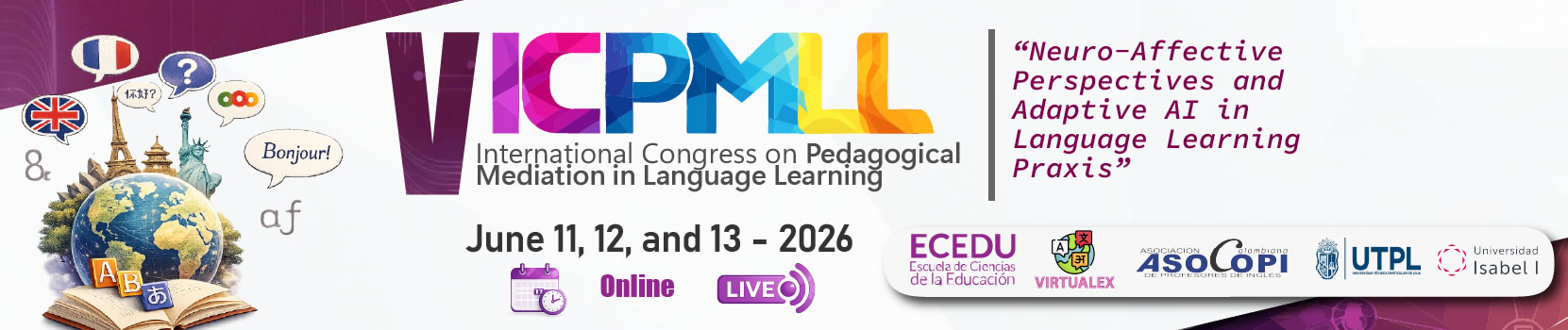
V International Congress on Pedagogical Mediation in Language Learning “Neuro-Affective Perspectives and Adaptive AI in Language Learning Praxis”
Propiedades del evento
| Fecha del evento | Jueves 11 Junio 2026 |
| Fecha de finalización del evento | Sábado 13 Junio 2026 |
| Capacidad | Ilimitado |
| Entrada / Inscripción | Entrada libre / Con inscripcion |
| Ubicación | Virtual |
Description of the Event
The International Congress on Pedagogical Mediation in Language Learning (ICPMLL) has established itself, throughout its four previous editions, as one of the epicenters of intellectual debate and pedagogical innovation in the field of language teaching in Colombia and Latin America. Since its launch in 2022, under the leadership of the School of Education Sciences (ECEDU), the Master's Program in Pedagogical Mediation in English Learning, and the VIRTUALEX research group at the National Open and Distance University (UNAD), the event has followed an upward trajectory in understanding how technology and pedagogy intertwine to transform educational realities. This fifth edition not only represents a commemorative milestone but also marks a paradigmatic shift by proposing a conceptual triad that responds to the most complex challenges of the 21st century: neuroscience, the affective dimension, and adaptive artificial intelligence.
The relevance of pedagogical mediation in language learning lies in its ability to act as a catalyst between the object of knowledge and the learner. In an educational ecosystem increasingly mediated by digital interfaces, the role of the teacher and the instructional designer has ceased to be that of mere transmitters of information and has instead become that of architects of learning experiences. However, this architecture cannot be static or merely intuitive. The foundation of the fifth edition of the congress rests on the premise that effective mediation must be grounded in scientific evidence about the functioning of the human brain, the role of the affective dimension and learner well-being, and the scope of AI-mediated instruction in language learning.
The convergence of these thematic axes positions the ICPMLL as a pioneering event that not only discusses the future of language education but also provides the theoretical and practical tools to build it from a scientific, humanistic, and technological perspective. It is, in essence, a call to the academic community to lead the transformation of educational practice under a model that recognizes that the brain that learns is a brain that feels, and that the most advanced technology is that which serves human well-being.
Main Speakers
Erika Galea – Ph.D.
Educational Neuroscience Hub
Visiting Lecturer University of Malta
Honorary Research Fellow UCL
Minlin Minny Zou
PhD Candidate at University of Exeter
Exeter, United Kingdom
Dr. Mark Warschauer
University of California, Irvine
School of Education
Irvine, CA USA
Dr. Jasone Cenoz
Educational Sciences Department
University of the Basque Country Spain
MA. Jennifer Betzabé Samaniego Franco
Analista de Innovación en la UTPL
Líder del XR LAB y el Club de Realidad Virtual Ecuador
MA. Paola Andrea Cardona Márquez
Master of Education in English Didactics
Universidad Católica Luis Amigo
IMPORTANT DATES
Close abstract submission: May 8, 2026
Acceptance notification: May 11, 2026
Full paper submission window: May 12–30, 2026
Selection of papers for book chapter & journal: May 26 - June 30, 2026
Objectives of the Event
The central objective of the V International Congress on Pedagogical Mediation in Language Learning is to consolidate a high-level academic and scientific exchange space that enables the analysis and integration of perspectives from cognitive neuroscience, the affective dimension, and adaptive artificial intelligence in pedagogical mediation for language learning. The congress seeks to foster the production of applied knowledge and the systematization of experiences that demonstrate how the convergence of these fields enhances learning effectiveness, promotes student well-being, and redefines the teaching role in digital and hybrid educational environments.
Specific Objectives
- To democratize access to cutting-edge scientific knowledge, facilitating the social dissemination of findings in neuroeducation and artificial intelligence among teachers, researchers, and diverse educational communities, in order to reduce the gap between academic production and pedagogical practice in vulnerable territories.
- To promote the social appropriation of knowledge through the creation of transnational collaboration networks that allow participants to exchange successful mediation experiences and innovative solutions, fostering a tangible impact on improving the educational quality of local and international communities.
- To critically evaluate the impact of adaptive technologies and language models, analyzing their capacity to personalize learning and manage students’ cognitive and emotional load, ensuring an ethical, inclusive, and human-centered pedagogical mediation.